







A Machine Built to Make History Ordinary
In 1986, the NASA Space Shuttle wasn’t just a spacecraft – it was the closest thing America had to a consumer technology platform. Designed as part of a broader integrated space transportation system, the shuttle carried with it a promise that orbital flight would become routine, even boring. Capsules from the Apollo era were one-and-done hardware; the shuttle was supposed to be different, fully reusable and capable of monthly ferry runs to low Earth orbit, with engineers entertaining the idea of weekly flights at its theoretical peak. It was, in the language of the era, infrastructure.
That framing matters when revisiting SpaceCamp, the 1986 film that dropped into theaters already complicated by tragedy. The movie arrived in a cultural moment when the shuttle had stopped feeling like inevitability and started feeling like hubris – and forty years on, watching it is less about nostalgia than about understanding how completely that particular vision of accessible space travel collapsed before it ever had a chance to fly.

The Shuttle as a Consumer Product
The commercial ambitions attached to the Space Shuttle program were not subtle. Coca-Cola and Pepsi both moved to extend their Cola Wars rivalry into orbit, treating the shuttle as advertising real estate with an altitude advantage. There were active plans to send Sesame Street’s Big Bird into space – not a metaphor, not a promotional stunt, but a serious logistical discussion about putting a large foam bird character aboard a spacecraft. The shuttle, at least in its promotional identity, was being positioned as something the public could participate in, a vehicle that would eventually have room for educators, journalists, entertainers, and eventually, ordinary people.
Christa McAuliffe was the most visible expression of that idea. Selected as part of NASA’s Teacher in Space program, she would have been the first private citizen to reach orbit – a proof-of-concept that the shuttle wasn’t just for astronauts and engineers. Her death in the Challenger disaster on January 28, 1986, along with the six other crew members, ended that experiment immediately and permanently. The civilian-in-space pipeline was shut down, and with it went Big Bird, the Cola Wars at altitude, and whatever remained of the shuttle’s identity as a mass-participation platform.
The Performance Gap Between Vision and Reality
Even before Challenger, the operational reality of the shuttle program was quietly undercutting the promises made at its inception. The shuttle’s most productive single year on record was 1985, when NASA managed nine flights in one calendar year. Nine. For a vehicle sold on the idea of monthly – or weekly – missions to low Earth orbit, nine flights across twelve months represented an enormous gap between the engineering brochure and the launch manifest.
Through most of the 1990s, the shuttle settled into a rhythm of five or six flights per year. That cadence kept the International Space Station program moving forward, supported scientific payloads, and maintained American presence in low Earth orbit. But it was nowhere near the transportation utility that had been projected when the program was conceived. The shuttle was fantastically advanced hardware – there is no serious argument otherwise – but it never achieved the operational tempo that would have made civilian access to space a realistic near-term prospect.
The gap between promise and delivery is worth sitting with when evaluating what SpaceCamp meant as a cultural object. The film was made in the window when the shuttle still carried its full aspirational weight, before the Challenger loss reframed everything. It was greenlit in an environment where putting a group of teenagers on the shuttle felt like a plausible enough premise for a light adventure film, not an absurdist premise requiring heavy suspension of disbelief. The shuttle, in that moment, was believable as the backdrop for an accidental launch.
After January 28, 1986, it became something else. The film opened in June of that year into a market still processing the Challenger disaster, and the premise – kids accidentally launched into orbit on a shuttle – carried a weight it was never designed to carry. Box office returns reflected that. The movie wasn’t equipped to be a meditation on risk and institutional failure; it was built to be a summer adventure film riding the shuttle’s aspirational momentum, and that momentum had been destroyed five months before the opening credits rolled.
What the Hardware Actually Was
Stripping away both the promotional language and the disaster narrative leaves a more complicated picture of what the shuttle program actually represented as a piece of engineering. The orbiter was genuinely extraordinary hardware for its time – a winged vehicle capable of reaching orbit, performing on-orbit operations, and returning to a conventional runway landing. Nothing before it or immediately after it could do all three of those things at once.
The 40-Year Reckoning
Reassessing SpaceCamp at forty years is really an exercise in reassessing the shuttle itself, and more specifically the gap between what the program was sold as and what it could operationally deliver. The shuttle’s ceiling of nine annual flights wasn’t a failure of ambition – it was a ceiling set by physical and logistical reality. Each orbiter required roughly 1,000 workers and a processing time measured in weeks between flights. The weekly ferry service to orbit was never a real number; it was a projection built to justify program costs, and it dissolved on contact with actual operations.
That context changes how the film reads. SpaceCamp wasn’t naive for using the shuttle as its technological centerpiece – in 1985 and early 1986, when the film was in production, NASA’s program was at the height of its launch frequency, with nine missions in 1985 alone. The premise made cultural sense. What the film couldn’t anticipate was that the same hardware generating that momentum was running on margins that couldn’t hold.

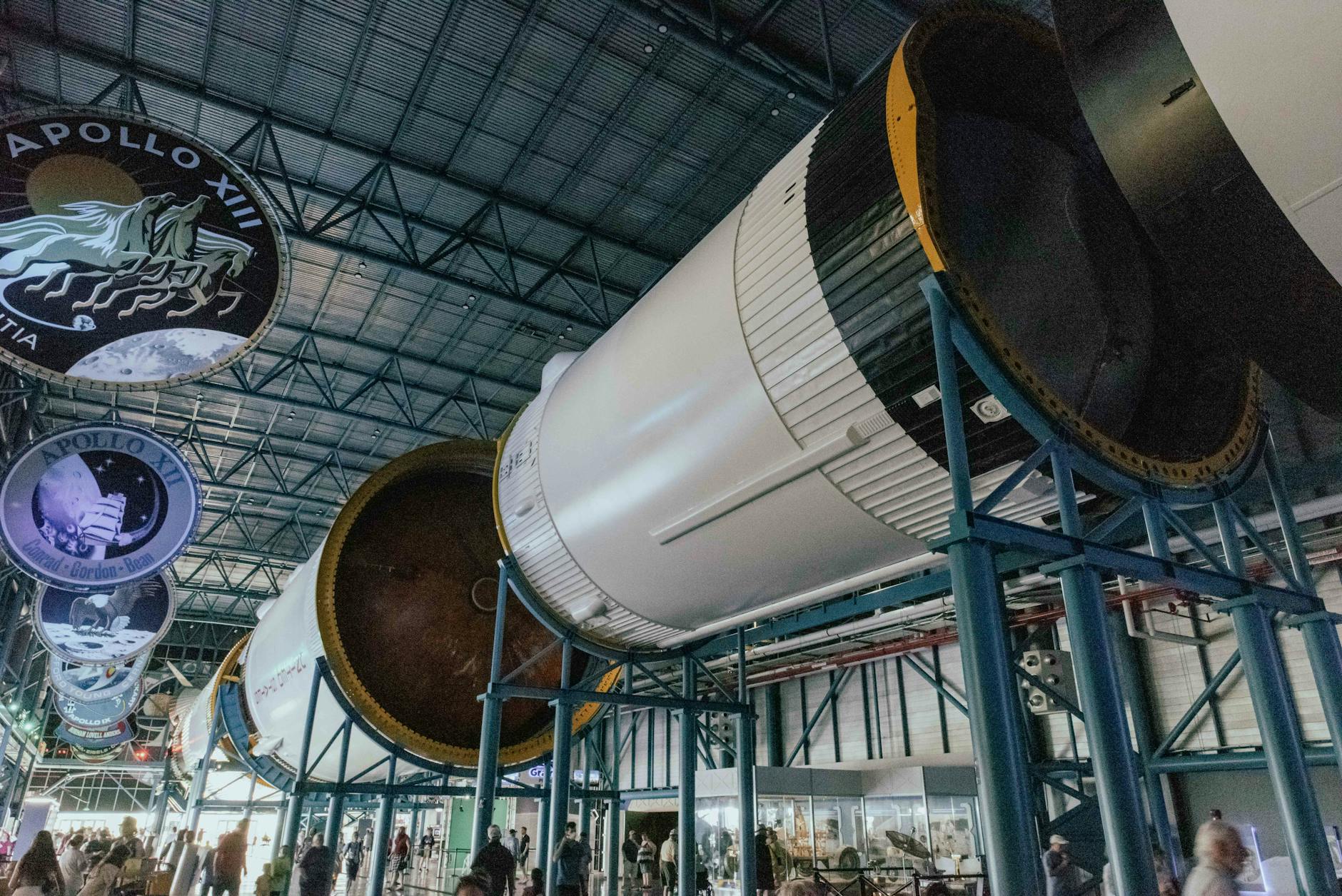
Forty years later, the shuttle fleet is in museums. The two orbiters lost – Challenger in 1986 and Columbia in 2003 – are memorialized rather than displayed. The civilian access that McAuliffe was meant to inaugurate eventually arrived through entirely different commercial channels, with no connection to the shuttle program that was supposed to open the door. Big Bird never made it to orbit. Coke and Pepsi eventually found other ways to market to the void. And a film made to celebrate a future that collapsed before its release date now functions as something the filmmakers never intended: an accidental document of exactly how brittle that particular vision of the future actually was.
What remains unresolved is whether the shuttle’s operational limitations were inherent to reusable orbital hardware at that technological moment, or specific to design choices made early in the program’s history that compounded over decades. Engineers still disagree.